


NoLow wines
NoLow wines require more than alcohol removal alone.
Discover Oenobrands’ technical approach to anticipate sensory balance throughout the winemaking process.
Intensified aroma
Enhancing expression and aromatic intensity significantly reduced after alcohol reduction.
Mouthfeel & structure
Helping preserve palate volume, balance and sensory coherence.
Wine matrix preparation
Anticipating the effects on acidity and astringency of dealcoholisation upstream during vinification.
REGULATORY AND TECHNICAL CONTEXT
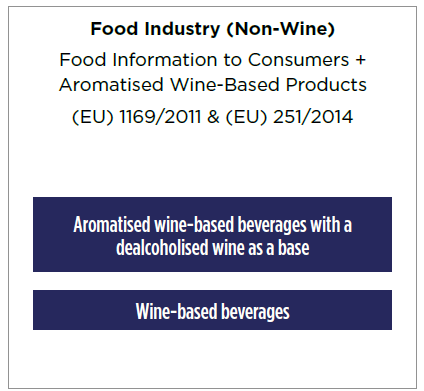
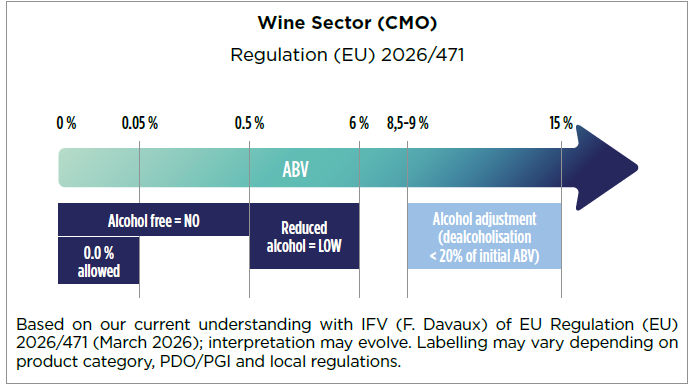
The regulatory framework distinguishes between the wine and non-wine sectors, with classification based on both final ABV and the level of alcohol reduction, in line with IFV (French wine and vine institute) guidance on definitions, authorised practices and labelling requirements.
To retain the “wine” designation, processes must comply with authorised oenological practices defined by EU Wine Regulation (EU) 2024/3085. Practices such as aromatisation or the addition of glycerol are not permitted for wines but are allowed for wine-based beverages.
TECHNIQUES FOR ALCOHOL REDUCTION
Three main technological approaches are used under EU and OIV regulations. Each method has a specific impact on the wine volume and aromatic matrix.
| Techniques | Partial dealcoholisation |
Total dealcoholisation |
Aroma recovery |
Alcohol removal |
Vol. loss / Alcohol by product |
|---|---|---|---|---|---|
| Must Desugaring (e.g. REDUX) |
(✓) only ~2% | ~ -2 % vol. | High (-20 % vol. for -2 % alc.) | ||
| Nanofiltration / Reverse osmosis + Distillation | ✓ | ✓ | (✓) Aroma preservation |
< 0.5 % vol. | ~ Alcohol volume |
| Nanofiltration / Reverse osmosis + Membrane contactor | ✓ | (✓) Aroma preservation |
Up to 6 % vol. | ~ Alcohol volume | |
| Low-temperature vacuum evaporation (Flash-derived) | ✓ | Aroma resynthesis during AF | Up to 6 % vol. | ~ 2x Alcohol volume | |
| Vortex vacuum evaporation |
✓ | ✓ (opt.) | ✓ (opt.) | 50-60 % | 1.8x Alcohol volume |
| Spinning Cone Column (SCC) | ✓ | ✓ | ✓ | 90-99 %* | 1.5x Alcohol volume |
| Vacuum distillation | ✓ | ✓ | ✓ | 90-99 %* | ~ Alcohol volume |
Source : IFV – F. Davaux. * Dependent on aroma recovery.
DEALCOHOLISATION & WINE BALANCE
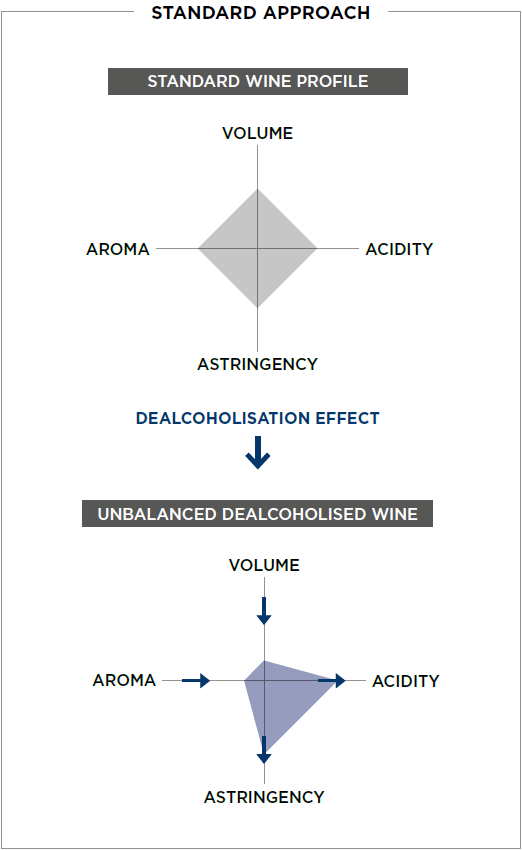
Dealcoholisation modifies wine balance regardless of the technology used.
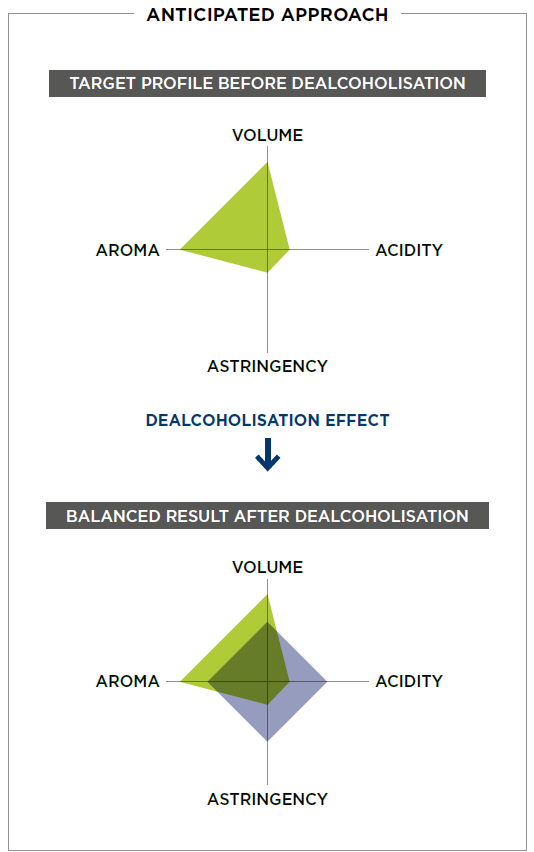
Anticipating these effects before alcohol reduction helps produce more balanced NoLow wines.
- Lowering alcohol affects every dimension of wine quality. Ethanol typically carries volatility, rounds the palate, stabilises colloids and softens phenolics; when it disappears, every weakness becomes more visible.
- NoLow wines therefore tend to show reduced aromatic intensity, a thinner and less cohesive palate, higher oxidative sensitivity and a greater risk of instability.
- Fermentation off-notes also emerge more easily because nothing masks them. The real challenge is not the dealcoholisation step itself.
Our strategy is to build aromatic intensity and structural stability upstream. By strengthening the wine’s matrix, we can ensure it withstands dealcoholisation without sensory collapse, while allowing for precise post-treatment adjustments.
Grapes themselves add constraints:
- thiol-driven cultivars are particularly delicate, as thiols are among the first aromatic compounds stripped during dealcoholisation.
- maturity must be managed with care to avoid excessive
acidity, ensuring ripe tannins and maximum aromatic
potential.
By adjusting the wine profile before dealcoholisation, the final balance can be brought closer to the target.
PRACTICAL NOLOW WINEMAKING APPROACH

GRAPES
Select grapes with optimal ripeness.
Higher alcohol is easier to manage than high
acidity or astringency.

ALCOHOLIC FERMENTATION
Enhance aromas with Anchor Legacy® VIN 13, WE 372, NT 202, the Alchemy’s, Fermivin® AR2, E73, P21.
Improve mouthfeel with Anchor Legacy VIN 2000, VIN 13, NT50, Fermivin 3C, Fermivin VINEAE.
Intensify aromas with autolysed yeast products like Natuferm®, providing organic nutrition to yeast and supporting the aroma metabolism.
Build body with Extraferm® D’fend and Rapidase Batonnage Liquid
MALOLACTIC FERMENTATION
Use co-inoculation with Anchor DUET or Maloferm Fruta DUO to manage acidity, aroma, accelerate processing and improve biological stability prior to dealcoholisation.
Recommended for red, rosé, and white.
DEALCOHOLISATION: Dealcoholisation remains a critical step requiring adaptation to each wine style and production objective.
MATURATION AND BOTTLING
Use Extraferm D’fend to restore body and protect the wine at this stage.
Enhance aroma release with Rapidase® Revelation Aroma.
Use Final touch® POP, TONIC or GUSTO mannoproteins to improve mouthfeel without adding sugars.
What about you?
With a highly qualified team of experts in many fields, Oenobrands strives to offer winemakers’ novel and scientifically sound solutions, as well as to highlight the positive synergies between its products.
Search your solution or product
Tell us about your difficulties, and we will answer you
Contact us