


Clarification by flotation has become a standard practice in many wineries thanks to its speed and operational efficiency.
However, flotation performance depends on several factors, and one of the most critical is often underestimated: the level of pectin degradation before clarification.
Pectins increase juice viscosity and reduce the separation efficiency between solids and liquid phases. Incomplete depectinisation can lead to slower flotation, larger lees volumes and lower juice recovery.
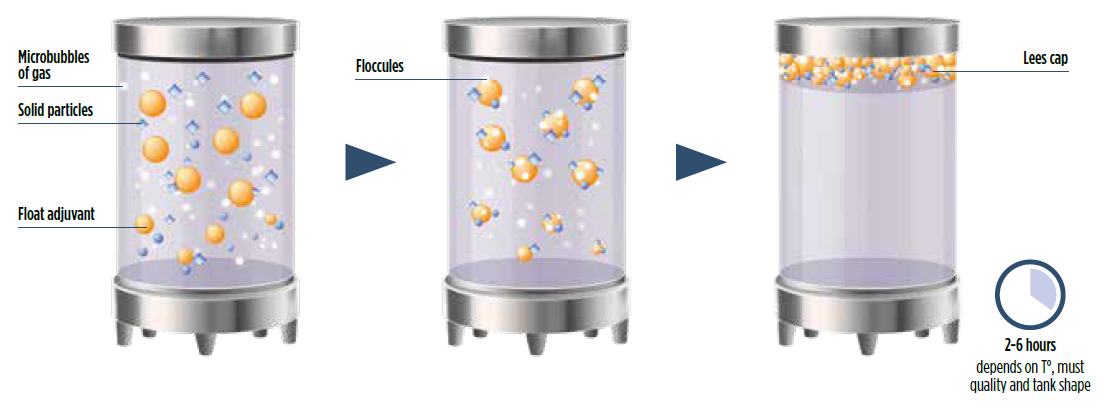
The flotation process relies on the formation and rise of flocs carrying suspended particles to the surface.
The role of pectolytic enzymes
Pectolytic enzymes are used before flotation to break down grape pectins and reduce viscosity.
When depectinisation is complete, suspended particles aggregate more efficiently and can be separated more rapidly during flotation. This improves clarification performance while helping preserve juice quality.
Why flotation enzyme performance matters
Not all enzyme preparations perform equally under flotation conditions.
Differences in pectolytic activity can influence:
- flotation speed
- compactness of the cap lees
- juice recovery
- final turbidity
These parameters directly affect winery efficiency and process reliability.
Measuring depectinisation before flotation
Monitoring pectin degradation before flotation remains the best way to secure clarification performance.
Simple pectin tests can help determine whether enzyme action is complete and whether the must is ready for flotation.
Read the full article in OENOBOOK 16.
In OENOBOOK 16, we compare the flotation performance of different enzyme preparations and discuss the impact of complete depectinisation on clarification efficiency and juice recovery.